|
Isn't it weird how sometimes you can listen to a record you totally hated a few months after the fact, just on a whim, and find that your opinion has completely changed? When …and You Will Know Us By The Trail of Dead's latest effort, Worlds Apart, came out in early 2005, I dismissed it as an over-produced, bombastic mess. And yet… I finally got what the band was going for with this heady (and critically thrashed) concept album.
Source: The Rich Girls Are Weeping.
|
dictionary.com: whim bombastic heady
Tell me now, what more do you need?
Take me to Walter Reed tonight
Baby I've lost the will for fighting
Over everything
And there's a few things I gotta say
Make no mistake, I'm mad
'Cause every good thing I had
Abandoned me
A sad and lonesome me
I'm the walking wounded
|
This song contains an extended metaphor that compares a dejected man frustrated by fighting with his partner to a wounded soldier. "Walter Reed" is an allusion to the Walter Reed Army Medical Center, which is part of a health care system operated by the U.S. Army. A broken heart rarely requires hospitalization, so Michael's request to be taken to Walter Reed is hyperbolic.
As the title of the song encompasses the metaphor and the comparison is the foundation of the lyrics, the song can be considered a conceit.
The verb "abandon" generally has a person as its subject: people abandon places ("to abandon a sinking ship," "to abandon a decrepit building"), other people ("to abandon one's child"), things and thoughts ("to abandon a car," "to abandon the idea of writing a novel"), and themselves to feelings ("to abandon oneself to grief"). Things rarely abandon people, so "every good thing I had abandoned me" can be considered an example of personification. It is unlikely that each and every good thing Michael has ever had "abandoned" him, so this is another example of hyperbole.
These lyrics contain two examples of alliteration: "Make no mistake, I'm mad" and "walking wounded."
dictionary.com: metaphor dejected allusion hyperbole personification explicit alliteration
|
Every time I close my eyes, I see you in front of me
Pretending in a love like this
I have no choice but to put you in back of me
Don't cover my footsteps
Dead weight all right, I know you're no good for me
Dead weight all right, I know you're no righteous leader
You're dead weight all right, that's fine, you get your hands off me
You have to touch me with kid gloves
|
These lyrics feature a common colloquial phrase that is considered to be an error in diction according to the rules of standard American English.
While the adverb phrase "in back of me" is antithetical to "in front of me," the proper idiom is "behind me." Employing the standard phrase would break the parallel structure of the antithesis, and the rhetoric of the chorus would be compromised. Remember that songwriters can flout the rules, but students should exercise caution when choosing words.
Also note the correct use of "all right" in this unofficial transcription. The commonly used "alright" is not a standard word and is acceptable in a colloquial context only.
dictionary.com: colloquial diction antithesis rhetoric flout
|
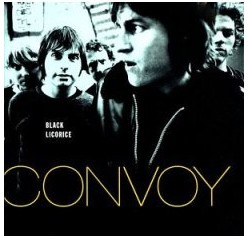
The rumours of music's demise have been, proverbially, exaggerated, as Convoy's Black Licorice, a magnum opus of genius pop craftsmanship, will attest. I will not go any further into the merits of this album, other than say that it is a compendium of practically any great band that has ever come out of the U.S. and the U.K., specially SoCal bands like the Beach Boys and Byrds, and England's Beatles, 'Stones, and T.Rex… Please, take my word for it… this was the best album of 2001 that I didn't even know existed. Someday, about 25 years from now or so… when Papa Roach and their fellow mediocre generic white-boy rappers and disgruntled Generation Y-ers have gone the way of "Rico Suave"… me and my best friend, whom I recommended this album to, and who loved it as much, will be drinking to our good fortune of having bought a CD which (from the looks of things) few other people bought, but which will still resonate as a great album for decades to come.
Source: Commenter Carlos R. Pastrana at Amazon.
|
dictionary.com: demise proverbial magnum opus compendium mediocre disgruntled resonate
|
Or Give Me Death, Aqueduct’s second full-length, is a difficult piece of work. It is both bold and timid, both dark and light, both tight and sprawling. Aqueduct, made up of Seattle’s David Terry, seems to avoid pigeon-holing and genre-labeling in ways no recent releases have been able to. It is almost frustrating how completely Terry eludes classification with this disc (his second on Barsuk Records) through a series of tracks full of opposing styles and tones. From start to finish, each number is melodic (yet dissonant) and melancholy (yet hopeful), but all are refreshingly innovative.
Source: PopMatters.
|
dictionary.com: timid genre elude dissonant melancholy innovative
|
Give 'Em Enough Rope, for all of its many attributes, was essentially a holding pattern for the Clash, but the double-album London Calling is a remarkable leap forward, incorporating the punk aesthetic into rock & roll mythology and roots music. Before, the Clash had experimented with reggae, but that was no preparation for the dizzying array of styles on London Calling. There's punk and reggae, but there's also rockabilly, ska, New Orleans R&B, pop, lounge jazz, and hard rock; and while the record isn't tied together by a specific theme, its eclecticism and anthemic punk function as a rallying call. While many of the songs — particularly "London Calling," "Spanish Bombs," and "The Guns of Brixton" — are explicitly political, by acknowledging no boundaries the music itself is political and revolutionary. But it is also invigorating, rocking harder and with more purpose than most albums, let alone double albums. Over the course of the record, Joe Strummer and Mick Jones (and Paul Simonon, who wrote "The Guns of Brixton") explore their familiar themes of working-class rebellion and antiestablishment rants, but they also tie them in to old rock & roll traditions and myths, whether it's rockabilly greasers or "Stagger Lee," as well as mavericks like doomed actor Montgomery Clift. The result is a stunning statement of purpose and one of the greatest rock & roll albums ever recorded.
- - -
Evidence of their grasp of the roots of rock & roll, on "Train in Vain" the Clash reference Robert Johnson in the title and Ben E. King in the chorus, though in the Clash song the jilted-lover protagonist bemoans "Did you stand by me/No not at all." With a funky popping guitar riff and a rootsy train whistle-like harmonica hook, the song stands as one of the most infectious and buoyant pop songs of the era. Sung with unwavering conviction, the song's irresistible melody is a memorable kiss-off anthem that now sounds at home on classic rock stations.
Source: allmusic.
|
dictionary.com: attribute aesthetic eclectic anthemic explicit invigorating maverick buoyant unwavering anthem