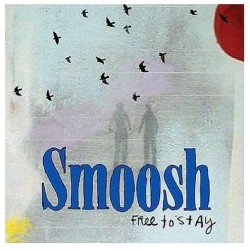
Smoosh's music generally falls into the category of "amiablemediocrity," but when you consider the fact that most people twice their age struggle to write and play as well as they can at their age, they totally deserve respect and support. If I was one of those Smoosh girls, I'd end every show by saying "We're, like, twelve or something, and you just got SMOOSHED!"
Note: The proper diction for a hypothetical situation is not "If I was"; rather, the use of the subjunctive "If I were" is considered to be standard in American English.
Every time I close my eyes, I see you in front of me
Pretending in a love like this
I have no choice but to put you in back of me
Don't cover my footsteps
Dead weight all right, I know you're no good for me
Dead weight all right, I know you're no righteous leader
You're dead weight all right, that's fine, you get your hands off me
You have to touch me with kid gloves
These lyrics feature a common colloquial phrase that is considered to be an error in diction according to the rules of standard American English.
While the adverb phrase "in back of me" is antithetical to "in front of me," the proper idiom is "behind me." Employing the standard phrase would break the parallel structure of the antithesis, and the rhetoric of the chorus would be compromised. Remember that songwriters can flout the rules, but students should exercise caution when choosing words.
Also note the correct use of "all right" in this unofficial transcription. The commonly used "alright" is not a standard word and is acceptable in a colloquial context only.
With "Bastards of Young," the Replacements' Paul Westerberg finally delivered the rock & roll anthem he'd always threatened — a rallying cry for a generation of misfits and ne'er-do-wells raised on false hopes and dim aspirationshopes, it's less about thwarting fate than accepting it, a celebration of resignation and defeat in the absence of anything else worth clinging to. "Dreams unfulfilled, graduate unskilled/It beats pickin' cotton and waitin' to be forgotten," Westerberg asserts, his ragged, world-weary voice pitted against a muscular guitar riff distilled from endless hours of classic rock radio; the matter-of-fact profundity of couplets like "The ones that love us best are the ones we'll lay to rest/And visit their graves on holidays at best/The ones who love us least are the ones we'll die to please" is startling — in his offhand, sheepishly poetic way, he captures life's most bitter ironies to perfection. Yet it's frustratingly appropriate that much of "Bastards of Young" is unintelligible, the poignancy and sensitivity of Westerberg's lyrics obscured by his deliberately half-assed diction — even the final, acerbic cries of "Take it, it's yours" blur together as the song crashes and burns. Also noteworthy is the "Bastards of Young" video clip — comprised of a single black-and-white take of a stereo blasting out the song, its utter contempt for the music video medium and the culture which spawned it is so hilariously palpable that in its own unique way, it's one of the landmarks of the form.
This site features words and concepts that are frequently found on such standardized examinations as the College Board's SAT, SAT Subject Test in Literature, and AP Tests in English Language and English Literature.
The mp3s on this site are for instructional and evaluative purposes only. We hope that you will enjoy learning as you listen and that you will support the artists if you like their music!